
Navigating international travel in 2026 requires more than just a passport and a dream. For many of the world’s most popular destinations, travel medical insurance is no longer just a recommendation—it is a mandatory legal requirement for visa approval. Whether you are applying for a Schengen Visa, a US J-1 Exchange Visitor visa, or a Digital Nomad permit in Southeast Asia, your choice of insurance can be the difference between a stamped passport and a costly rejection.
In this comprehensive guide, we break down the specific insurance mandates for major global regions, how to obtain a “Visa Letter,” and how to choose a policy that protects both your health and your travel investment.
1. Why Insurance is Mandatory for Visa Approval
Embassies and consulates require proof of insurance to ensure that foreign visitors do not become a financial burden on their public healthcare systems. If a traveler falls ill or has an accident without coverage, the host country’s taxpayers often end up footed with the bill.
By mandating travel health insurance, governments guarantee that:
- Emergency medical costs are pre-paid by a private insurer.
- Medical evacuation (repatriation) back to the home country is financially covered.
- The traveler has access to high-quality private care without delays.
2. Schengen Visa Insurance Requirements (Europe)
The Schengen Area—comprising 29 European countries including France, Germany, Italy, and Spain—has some of the strictest insurance regulations in the world. To secure a Schengen Type C (Short-stay) Visa, your policy must meet these four non-negotiable criteria:
| Requirement | Specification |
| Minimum Coverage | At least €30,000 (approx. $33,000 USD). |
| Territorial Validity | Must be valid in all Schengen member states. |
| Repatriation | Must cover medical evacuation and repatriation of remains. |
| Duration | Must cover the entire duration of the stay (entry to exit date). |
3. US Visa Insurance Mandates (J-1, J-2, and New Regulations)
Unlike the Schengen Area, the United States does not require medical insurance for standard B1/B2 tourist visas. However, for J-1 Exchange Visitors and their J-2 dependents, the U.S. Department of State mandates specific coverage levels:
- Medical Benefits: At least $100,000 per accident or illness.
- Medical Evacuation: At least $50,000.
- Repatriation of Remains: At least $25,000.
- Deductibles: Cannot exceed $500 per accident or illness.
- Underwriter Rating: The insurance company must have an A.M. Best rating of “A-” or above or a Standard & Poor’s rating of “A-” or above.
4. Digital Nomad and Long-Stay Visas
With the rise of “Work from Anywhere” programs, countries like Portugal, Thailand, and Costa Rica have introduced Digital Nomad Visas. These often require “Global Health Insurance” rather than simple travel insurance.
- Thailand (LTR Visa): Requires at least $50,000 in health insurance coverage.
- UAE (Remote Work Visa): Proof of valid health insurance with UAE coverage is required for the duration of the one-year permit.
5. Key Coverage Features to Look For
To attract the best rates and ensure your visa isn’t denied, look for these specific “High-Value” features in a policy:
Emergency Medical Evacuation
This covers the cost of transporting you to a specialized hospital or back to your home country via air ambulance. Without this, a medevac flight can cost upwards of $100,000 out of pocket.
Direct Billing vs. Reimbursement
High-quality insurers offer direct billing, meaning they pay the hospital directly. Lower-end “reimbursement-only” plans require you to pay thousands of dollars upfront and file a claim later—a risky move for many travelers.
24/7 Assistance Hotline
Consulates value policies from providers that offer a 24-hour emergency coordination center. This ensures that help is available regardless of time zones.
6. How to Get a “Visa Letter” (Proof of Coverage)
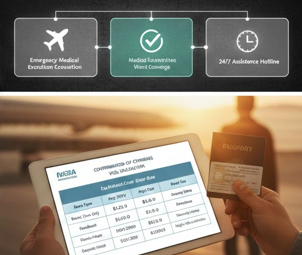
Once you purchase your policy, you cannot simply show a receipt to the embassy. You need a Visa Letter (also known as a Confirmation of Coverage). A valid visa letter should include:
- Your Full Name (exactly as it appears on your passport).
- Policy Number.
- Dates of Coverage.
- Geographic Scope (e.g., “Valid Worldwide including Schengen Area”).
- Specific Mention of Repatriation and Emergency Medical limits.
7. Common Pitfalls That Lead to Visa Rejection
Avoid these common mistakes to ensure your application is processed smoothly:
- Incorrect Dates: If your flight lands at 11:00 PM on Monday, but your insurance starts on Tuesday, your visa may be rejected.
- Insufficient Limits: Buying a policy with a $25,000 limit when the embassy requires €30,000.
- Exclusion of “Dangerous Activities”: If you plan to ski or scuba dive, ensure your policy doesn’t exclude these, as some embassies check for comprehensive protection.
- Non-Accredited Providers: Some countries only accept insurance from companies on their “Approved List.” Always check the local embassy website first.
8. Estimated Costs of Travel Medical Insurance
In 2026, travel medical insurance is surprisingly affordable. For a 30-year-old traveler visiting Europe for two weeks, costs generally range from $1.50 to $4.00 per day.
| Plan Type | Avg. Daily Cost | Best For |
| Basic (Visa Only) | $1.20 – $2.00 | Schengen Visa compliance on a budget. |
| Standard | $2.50 – $5.00 | Families, older travelers, and multi-country trips. |
| Premium | $6.00+ | J-1 Scholars, high-risk activities, and zero-deductible plans. |
9. Conclusion: Don’t Risk Your Trip
Securing the right travel medical insurance for visa approval is about more than just checking a box on an application form. It is about protecting your health, your finances, and your ability to travel freely. By choosing a plan that meets specific embassy mandates, you can walk into your visa interview with confidence.