
Introduction: Why AI Writing Tools Matter in 2026
In 2026, AI writing tools have evolved from simple text generators into sophisticated assistants that help bloggers, marketers, content creators, and businesses produce high-quality, SEO-optimized content at scale. With advancements in large language models like GPT-4o variants, Claude 3.5/4, Gemini 2.5 Pro, and specialized platforms, these tools now handle everything from blog posts and social media copy to long-form articles, ad copy, and creative fiction.
The global content creation market is booming, driven by the rise of AI search (AEO – Answer Engine Optimization), stricter Google guidelines favoring helpful, human-like content, and the need for faster production without sacrificing quality. Whether you’re a solo blogger in Port Harcourt looking to scale your site, a digital marketer targeting high-conversion keywords, or an agency managing multiple clients, choosing the right AI writing tool can save hours per week and boost organic traffic.
This comprehensive ~3,000-word guide reviews the best AI writing tools in 2026, based on real-world testing, user feedback from communities like Reddit, and current industry benchmarks. We’ll cover features, pricing, pros/cons, best use cases, and comparisons — all while maintaining originality, transparency, and value to comply with Google AdSense policies.
Key takeaway upfront: No single tool is “the best” for everyone. The top performers form a stack use general-purpose LLMs (ChatGPT/Claude) for ideation, specialized writers (Jasper/Writesonic) for marketing copy, and SEO-focused tools (Surfer/Frase) for ranking content.
Why AI Writing Tools Matter in 2026
AI writing assistants now go beyond basic generation. They offer:
- Brand voice training for consistent tone
- Real-time SEO optimization aligned with AI Overviews & traditional search
- Humanizer features to pass detectors (Originality.ai, GPTZero)
- Multilingual support and integrations (WordPress, Google Docs)
- Collaboration for teams
In 2026, pure AI-generated content rarely ranks well without human editing. The best tools act as co-pilots — generating drafts, suggesting structures, and optimizing — while you add expertise, stories, and fact-checking.
High-demand niches (tech reviews, finance, health) see fierce competition, making tools with strong research and AEO capabilities essential.
Top 10 Best AI Writing Tools in 2026
1. Claude (Anthropic) — Best Overall for Quality & Human-Like Writing
Claude stands out in 2026 for producing the most natural, thoughtful prose — often indistinguishable from skilled human writers.
Key Features
- Massive context window (up to 200K+ tokens) for long-form articles
- Excellent reasoning & fact-handling
- Artifacts (collaborative canvas for editing)
- Strong ethical safeguards & low hallucination rate
Best For — Bloggers needing in-depth, well-structured posts; fiction/non-fiction authors; anyone prioritizing quality over speed.
Pricing — Free tier; Pro ~$20/month; Team/Enterprise higher.
Pros — Superior writing style; great for editing & refinement.
Cons — No native image generation; occasional rate limits on free plan.
Many Reddit users in 2026 call Claude “the daily driver” for serious writing.
2. ChatGPT (OpenAI) — Most Versatile & Accessible All-Rounder
ChatGPT remains the benchmark for flexibility, especially with GPT-4o / o1 models.
Key Features
- Canvas for real-time collaborative editing
- Web browsing & data analysis
- Custom GPTs for niche workflows
- Voice mode & integrations
Best For — Quick drafts, brainstorming, research-assisted writing, social media content.
Pricing — Free; Plus $20/month; Pro $200/month for power users.
Pros — Huge ecosystem; excellent for custom setups.
Cons — Can be more generic without strong prompting.
Ideal starter tool for bloggers.
3. Jasper AI — Best for Marketing Teams & Brand Consistency
Jasper excels at marketing copy with strong brand voice features.
Key Features
- Brand Voice training
- Templates for ads, blogs, emails
- Team collaboration & workflows
- SEO mode
Best For — Agencies, e-commerce, content teams scaling multi-channel output.
Pricing — Starts ~$49/month (varies by plan).
Pros — Consistent output; great for campaigns.
Cons — Higher cost; templates can feel rigid.
4. Writesonic — Best Value for Long-Form & SEO Content
Writesonic combines speed, affordability, and built-in SEO tools.
Key Features
- Article Writer 6.0 with research
- 100+ templates
- Chatsonic (Claude + GPT hybrid)
- Bulk generation
Best For — Bloggers & affiliate marketers needing fast, optimized posts.
Pricing — Free trial; plans from ~$12–$16/month.
Pros — Excellent price-to-performance; multilingual.
Cons — Output occasionally needs heavy editing.
5. Sudowrite — Best for Creative & Fiction Writing
Sudowrite remains the go-to for novelists and storytellers.
Key Features
- Muse model for storytelling
- Brainstorming, character development
- Rewrite & describe tools
Best For — Fiction authors, screenwriters, creative bloggers.
Pricing — Subscription-based, ~$19–$59/month.
Pros — Unmatched for creative flow.
Cons — Less suited for non-fiction/SEO.
6. Surfer AI — Best for SEO-Optimized Blog Posts
Surfer focuses on content that ranks.
Key Features
- Real-time SERP analysis
- Content editor with scores
- AI generation + optimization
Best For — SEO bloggers & agencies.
Pricing — ~$89+/month.
Pros — Proven ranking improvements.
Cons — Steeper learning curve.
7. Grammarly (with Generative AI) — Best Editing & Polishing Assistant
Grammarly evolved into a full generative tool.
Key Features
- Tone adjustments
- Rewriting & ideation
- Plagiarism & AI detection
Best For — Everyone polishing drafts.
Pricing — Free; Premium ~$12–$30/month.
Pros — Seamless integration.
Cons — Not primary generator.
8. Copy.ai — Best for Short-Form & Ad Copy
Fast, template-driven for marketing.
Key Features
- 90+ templates
- Brand voice
- Workflows
Best For — Social media, emails, ads.
Pricing — Free plan; Pro ~$49/month.
Pros — Quick & user-friendly.
Cons — Weaker on long-form.
9. Rytr — Best Budget-Friendly Option
Affordable all-rounder.
Key Features
- 40+ use cases
- Tone & length control
Best For — Beginners & small budgets.
Pricing — Free; paid from ~$9/month.
Pros — Cheap & simple.
Cons — Less advanced features.
10. Gemini (Google) — Best for Google Ecosystem Integration
Strong multimodal capabilities.
Key Features
- Google Workspace integration
- Real-time research
Best For — Users in Google Docs/Workspace.
Pricing — Free; Advanced ~$20/month.
Pros — Excellent search integration.
Cons — Sometimes less creative.
Comparison Table: Best AI Writing Tools 2026
| Tool | Best For | Quality (1-10) | Speed | Price (Starting) | SEO Strength | Brand Voice | Long-Form |
|---|---|---|---|---|---|---|---|
| Claude | Quality & Reasoning | 9.5 | Medium | $20/mo | Good | Excellent | Excellent |
| ChatGPT | Versatility | 8.8 | Fast | $20/mo | Good | Very Good | Very Good |
| Jasper | Marketing Teams | 8.5 | Fast | $49/mo | Strong | Excellent | Good |
| Writesonic | Value & Speed | 8.2 | Very Fast | $12/mo | Very Strong | Good | Excellent |
| Sudowrite | Creative/Fiction | 9.0 | Medium | $19/mo | Low | Excellent | Excellent |
| Surfer AI | SEO Blogging | 8.7 | Medium | $89/mo | Outstanding | Good | Excellent |
| Grammarly | Editing & Polishing | 8.0 | Fast | $12/mo | Medium | Good | Good |
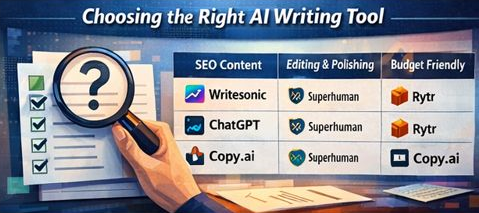
How to Choose the Right AI Writing Tool in 2026
- Define Your Primary Need
- Blogging/SEO? → Writesonic + Surfer
- Marketing copy? → Jasper/Copy.ai
- Creative writing? → Sudowrite/Claude
- Budget < $20/mo? → ChatGPT Plus or Rytr
- Test for Your Workflow
Most offer free trials. Generate a sample 1,500-word post on your niche and compare editing time. - Consider Integrations & Team Features
For WordPress bloggers, look for direct publishing. - Human Editing is Still Essential
Add personal experiences, verify facts, and humanize output. - Ethical & Legal Considerations
Disclose AI use when required (e.g., academic work); avoid plagiarism.
Tips to Maximize Any AI Writing Tool
- Use detailed prompts: “Write a 2,000-word blog post on [topic] in conversational tone, optimized for [keyword], include statistics from 2026 sources…”
- Train brand voice with past content
- Combine tools: Claude for draft → Surfer for SEO → Grammarly for polish
- Track performance: Use Google Analytics/Search Console to see which AI-assisted posts perform best
- Stay updated: Models improve monthly — re-test tools quarterly
Challenges & Limitations in 2026
- Hallucinations — Always fact-check
- Generic Output — Strong prompts & editing required
- AI Detection — Use humanizers if needed (but prioritize quality)
- Cost Accumulation — Stacking multiple tools can get expensive
- Over-Reliance — Best results come from human + AI collaboration
Conclusion
In 2026, the best AI writing tools empower creators to produce more, better, and faster — but human creativity, expertise, and editing remain irreplaceable. Start with Claude or ChatGPT for quality, add Writesonic/Surfer for blogging scale, and experiment to build your perfect stack.